
Advisory · Process Fit Diagnosis
Find where the process bends to the tool.
Business process consulting for operators whose teams work around their software. We map how work actually moves, find the CRM contortions, five-tool stitches and spreadsheet layers, price what they cost and name the fix.
Why this exists
Process problems usually look like people problems.
Missed handoffs, double entry, a report that takes two days to build. It looks like a training issue or a headcount issue. Usually it is neither: the process has been bent to fit the tools, and people are absorbing the difference by hand.
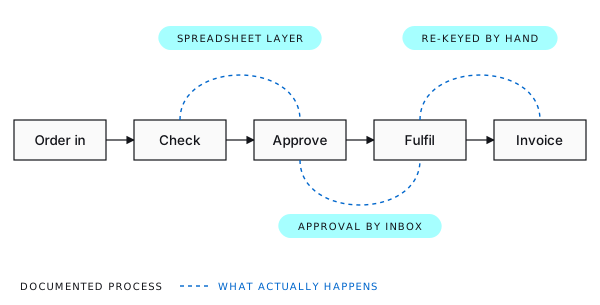
Our business process consulting maps the work as it really happens, not as the process document says. We follow a transaction from start to finish, count the tools it touches and price every manual step it takes to keep it moving.
Then we name the fix. Sometimes that is configuration you already pay for. Sometimes it is automation. Sometimes it is a small owned tool that replaces the stitch. We say which, and we say when the right answer is to leave it alone.
Problems we solve
The misfits we find. And price.
The spreadsheet layer
The real process lives in a spreadsheet next to the system, because the system can't express it. Every copy and paste is a cost and a risk.
The five-tool stitch
One workflow crosses five tools, held together by integrations, exports and someone's memory.
CRM contortions
A sales or service motion forced into a CRM's standard objects, with the real pipeline kept somewhere else.
Swivel-chair handoffs
Data retyped from one system to the next between teams, with errors found weeks later.
Approvals by inbox
Decisions that should take minutes wait in email threads, with no record of who approved what.
Deliverables
What you get. Priced and ranked.
Process map as it really runs
Every step, handoff, tool and workaround for the processes in scope, drawn from the people who do the work.
Misfit cost
What each workaround costs per year in hours, errors and delay, so fixes can be ranked by value.
Fix per misfit
For each one: configure, automate, replace or build, with rough cost and effort.
Target process
The redesigned process, shaped to how the team should work rather than to what a tool allows.
Automation shortlist
The steps worth automating first and the ones that should stay human.
Recommendation
One prioritised plan you can execute with your own team, a vendor or us.
How it runs
Map. Price. Decide.
Step 1 · 1–3 weeks
Map
Interviews and shadowing with the people who run the process. Every tool, handoff and workaround recorded.
Step 2 · 1 week
Price
Each misfit costed in hours, errors and delay. The few that matter separated from the many that don't.
Step 3 · 1–2 weeks
Decide
Target process and a ranked fix list. Act on it alone, move into a Process Build or keep us on as adviser.
Who this is for
Operators with a decision on the desk.
Operations leaders
Your team is busy all day and output isn't moving. You suspect the tools but need the evidence.
Sales and service heads
The CRM is the system of record on paper. In practice the pipeline lives in a spreadsheet.
Founders and COOs
Growth is adding headcount faster than revenue and you want to know how much of it is workaround.
How we compare
The same question, three ways to answer it.
Common questions
What is business process consulting?
It is the work of finding how a business actually operates, where that process breaks down and what to change. Ours focuses on where processes and software don't fit each other.
How is this different from Lean or process improvement?
Lean improves the process within the tools you have. We also question the tools: whether the misfit is the process, the software or the space between them.
Do you always recommend new software?
No. Often the fix is configuration you already pay for or a change in how teams hand work over. We only recommend building when it pays back.
Which processes do you look at?
Sales pipeline, order to cash, procurement, recruitment, service delivery and the operational workflows unique to your business.
How do you measure the cost of a misfit?
Hours spent on workarounds, error and rework rates, delay between steps and tool spend, all annualised.
What happens after the recommendation?
You can act on it with your team or any vendor. If a Process Build is the answer, we can deliver it in two to eight weeks.
Related services
- BuildBusiness Process AutomationBusiness process automation that replaces tool stitches and manual handoffs with one owned workflow tool.
- AdvisoryTechnology Strategy ConsultingIndependent technology strategy consulting for founders, operators and boards.
- AdvisoryAI Strategy ConsultingAI strategy consulting that decides where AI belongs in your business: what to build AI-native, what to add AI to later and what to leave alone.
- PillarAdvisory overviewSix advisory domains and how an engagement runs, from diagnosis to decision.
Know a process your team works around?
Book a discovery call. Bring one workflow and we'll show you how we would map and price it.
01Book a Discovery CallAdvisory starts with a discovery call