
Advisory · Software & Platform Strategy
Technology strategy that ends in a decision.
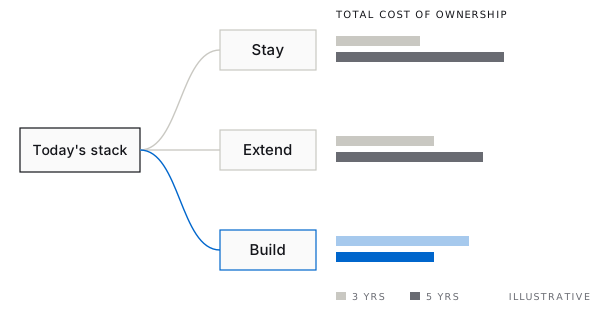
Independent technology strategy consulting for operators who need a decision, not another roadmap. We assess your stack, your process and your growth plan, then return one written recommendation: stay, extend or build, priced over three and five years.
Why this exists
Most technology strategies describe the stack. Few decide anything.
A typical technology strategy engagement ends with a current-state diagram, a target-state diagram and a roadmap between them. It looks thorough. It rarely answers the question that started the project: should we keep this platform, extend it or replace it?
Our technology strategy consulting starts from that question. We look at what your business actually does, where the systems bend it out of shape and what the misfit costs per year. Then we price the options honestly, including the option of changing nothing.
We have no licence to resell and no implementation hours to protect. That is why the answer can be trusted: the recommendation is the deliverable, not the door to a larger contract.
Problems we solve
Where technology strategy stalls. The questions we answer.
Build vs buy, decided by default
A SaaS renewal arrives or a customisation quote lands, and the decision is made by whoever holds the contract. We make the comparison explicit, with total cost over three and five years.
A stack that grew by accident
Twenty tools, three doing the same job, none owning the data. We rationalise the stack against the process it is meant to serve.
Architecture that won't survive the next stage
What worked at ten people and one market breaks at fifty people and three. We test the architecture against your growth plan, not a generic maturity model.
Platform replacement with no clear case
The team wants off the platform. The vendor says one more module will fix it. We assess which is true and what replacement would really cost.
Technical debt nobody has priced
Everyone knows it is there. Nobody can say what it costs or what to fix first. We audit it and rank it by business impact.
Deliverables
What you get. In writing.
Written recommendation
One answer, not a three-option deck: stay, extend or build, with reasoning a board can follow.
TCO and ROI model
Each path costed over three and five years: licences, customisation, maintenance and the operating cost of the misfit itself.
Systems inventory
Every tool, integration and data flow mapped, with owner, cost and overlap marked.
Target architecture
The architecture the recommendation implies: what stays, what goes and what connects to what.
Sequenced roadmap
What to do first, what can wait and what to stop doing, in quarters rather than years.
Risk register
What could go wrong on each path and how to reduce it before you commit.
How it runs
Diagnose. Decide. Close or continue.
Step 1 · 1–4 weeks
Diagnose
Stakeholder interviews, systems inventory and real cost analysis. We map where technology is breaking down and what it costs you per year.
Step 2 · 1–2 weeks
Decide
The written recommendation, backed by TCO and ROI over three and five years. Reviewed with you and your sponsor before it is final.
Step 3 · your choice
Close or continue
Act on the document alone, move into a Build, keep us on as adviser or get referred to the right partner.
Who this is for
Operators with a decision on the desk.
Founders at a growth inflection
The stack that got you here is starting to cost more than it returns. You need to know whether it survives the next stage.
SME and mid-market operators
A renewal, a customisation quote or a replacement proposal is on the desk and the number feels wrong.
Boards and sponsors
You need an independent read on technology direction before money moves, from someone with nothing to sell afterwards.
How we compare
The same question, three ways to answer it.
Common questions
What does a technology strategy consultant do?
They help you decide what technology the business should run on and why. Ours assesses your systems against your process and growth plan and returns a single recommendation with the costs behind it.
How is this different from an IT strategy roadmap?
A roadmap sequences work you have already decided to do. We decide first: stay, extend or build. The roadmap follows from that decision.
How long does a technology strategy engagement take?
Usually two to six weeks: one to four weeks to diagnose and one to two weeks to decide.
Do you recommend software vendors?
Yes, when buying is the right answer. We take no referral fees or reseller margin, so a recommendation to buy is as independent as one to build.
Can you review a vendor proposal we already have?
Yes. A proposal or customisation quote on the desk is one of the most common starting points. We test it against your process and the alternatives.
What if the answer is to build?
You can take the recommendation to any team. If you want us to build it, the work moves into our Build service with the diagnosis already done.
Related services
- AdvisoryBusiness Process ConsultingBusiness process consulting that finds where your teams bend to their tools, prices the misfit and names the fix: configure, automate, replace or build.
- AdvisoryAI Strategy ConsultingAI strategy consulting that decides where AI belongs in your business: what to build AI-native, what to add AI to later and what to leave alone.
- BuildCustom Software DevelopmentCustom software development for businesses whose process doesn't fit off-the-shelf tools.
- PillarAdvisory overviewSix advisory domains and how an engagement runs, from diagnosis to decision.
Have a technology decision on the desk?
Start with a discovery call. We'll tell you whether it needs a full engagement or a straight answer.
01Book a Discovery CallAdvisory starts with a discovery call