
Build · Platform Build
Enterprise platforms, without the enterprise timeline.
Enterprise software development for organisations whose core platform no longer matches the business. We replace or extend ERP, property, order and operations platforms across departments, sites and entities, in six to eighteen months, with full ownership at handover.
Why this exists
Enterprise software projects fail on scope, not code.
Large platform programmes are usually sold as one big transformation: a long discovery, a large team and a go-live date years away. By the time it lands, the business has moved.
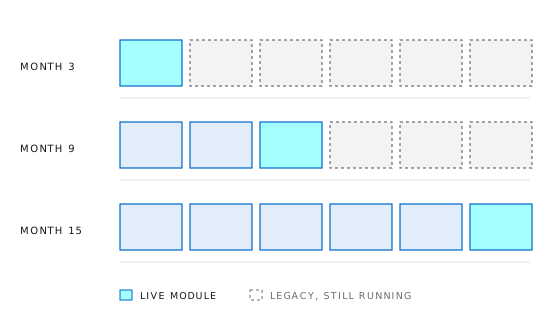
We run enterprise software development differently. The platform is delivered in working slices, each one used in production before the next begins. Legacy systems are replaced module by module, so the business keeps running while the platform changes underneath it.
The team stays small and senior, working with AI agents to compress the timeline. Security, integration and governance are designed in from the first sprint, not reviewed at the end.
Problems we solve
When the platform no longer fits. Across the whole business.
Every department has its workaround
The core platform serves no one well, so each team has built its own way around it.
Legacy systems nobody wants to touch
Core business logic in software that is costly to change and hard to staff.
ERP extended past its limits
Customisations stacked on the ERP until every upgrade is slow and risky.
Multi-entity, multi-market complexity
Sites, entities, currencies and regulations the platform was never designed for.
The vendor's roadmap isn't yours
Your priorities wait in someone else's release queue.
Deliverables
What you get. Built to scale, owned outright.
Platform architecture
Modular design covering domains, data, integration and security, built to grow with the business.
Migration plan
Module-by-module replacement of legacy systems, with data migration and parallel running.
Integration layer
Connections to the ERP, CRM, finance, identity and data platforms you keep.
Security and governance
Role-based access, audit trails, compliance controls and environments set up from the start.
Working slices in production
Releases used by real teams throughout the programme, not one go-live at the end.
Full ownership and handover
Code, infrastructure, documentation and runbooks transferred to your team.
How it runs
Delivered in slices. Live throughout.
Phase 1 · 2 weeks
Fit Assessment
Platform scope, legacy landscape and integration map. A recommended replacement sequence.
Phase 2 · 2–4 weeks
Architecture
Platform architecture, security model and migration plan, reviewed with your IT and governance teams.
Phase 3 · 6–18 months
Build in slices
Two-week sprints. Each module goes live and is used before the next starts.
Phase 4 · 2–4 weeks
Handover
Knowledge transfer to your engineering team, with an optional support period.
Who this is for
Operators with a decision on the desk.
CIOs and CTOs
You need to replace or extend a core platform without a multi-year programme.
Multi-site and multi-entity operators
Your platform must handle sites, entities and markets it was never built for.
Organisations on legacy systems
Core logic sits in software that is expensive to maintain and risky to change.
How we compare
The same question, three ways to answer it.
Common questions
What is enterprise software development?
Building or replacing the platforms that run an organisation across departments, sites or entities, with the integration, security and governance that scale demands.
How is this different from custom software development?
Same model, larger scope. Enterprise work covers platforms that span the whole business, replace legacy systems or extend an ERP, with heavier integration and governance.
Can you work with our IT and security teams?
Yes. Architecture, security and governance are reviewed with your teams from the start, and we work within your environments and policies.
Do you replace our ERP?
Sometimes. More often we extend it: we build the operational platform around the ERP and leave finance and accounting where they are.
How do you migrate from legacy systems safely?
Module by module, with data migration, parallel running and a switch-over plan for each slice.
How long does an enterprise build take?
Six to eighteen months, with working modules in production throughout.
Related services
- BuildCustom Software DevelopmentCustom software development for businesses whose process doesn't fit off-the-shelf tools.
- AdvisoryTechnology Due DiligenceIndependent technology due diligence for PE firms, investors and boards.
- AdvisoryTechnology Strategy ConsultingIndependent technology strategy consulting for founders, operators and boards.
- PillarBuild overviewThree build scales, four delivery phases and full ownership at handover.
Platform no longer fits the business?
A two-week Fit Assessment maps the platform, the legacy landscape and the right replacement sequence.
02Book a Fit AssessmentBuild starts with a two-week Fit Assessment