
Build · Process Build
Automate the process, not the workaround.
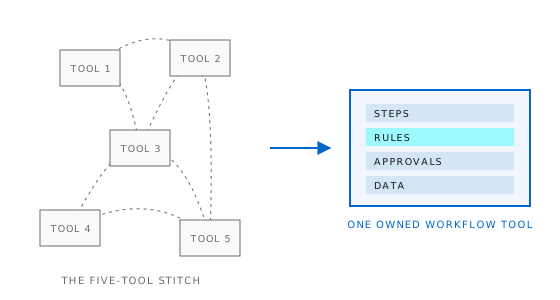
Business process automation for teams holding a workflow together by hand. We replace the five-tool stitch, the spreadsheet layer and the swivel-chair handoff with one owned tool, delivered in two to eight weeks.
Why this exists
Most automation connects the tools. We remove the need to.
The usual automation answer is more glue: another integration platform, another set of triggers between tools that were never meant to work together. It moves the data faster. It also adds another system to maintain and another place for things to break.
Our business process automation starts by asking whether the stitch should exist at all. Often the better answer is one owned tool shaped to the workflow, with automation built in rather than bolted between apps.
These are Process Builds: two to eight weeks, two or three senior engineers and working software every sprint. Small enough to start fast, owned outright when it is done.
Problems we solve
The manual work we automate. Usually in weeks.
Data re-entered between systems
Orders, candidates, invoices or tickets retyped from one tool to the next.
Integrations held together by hand
A chain of no-code automations that breaks quietly and needs someone to watch it.
Approval chains in email
Requests, sign-offs and exceptions that wait in inboxes with no audit trail.
Reports rebuilt every week
Reports assembled by exporting from four tools into one spreadsheet.
Exceptions handled from memory
The edge cases only one person knows how to process.
Deliverables
What you get. One tool, not more glue.
Workflow map
The process as it runs today and as it will run once automated, signed off by the team that uses it.
One owned workflow tool
Replaces the stitch: steps, rules, approvals and data in one place.
Integrations that stay
Clean connections to the systems you keep, with monitoring and alerts.
Rules and AI where they help
Routing, validation and document handling automated. Judgement calls left to people.
Audit trail and reporting
Who did what and when, with live reporting instead of weekly exports.
Handover
Code, infrastructure and documentation handed over. No per-run or per-seat fees.
How it runs
Two to eight weeks. In use before it's finished.
Weeks 1–2
Fit Assessment
The workflow mapped and priced. Confirmation that a Process Build is the right scale.
Weeks 2–3
Design
Screens, rules and integrations specified and agreed with the team that will use them.
Weeks 3–8
Build
Two-week sprints with demos. The team starts using it before it is finished.
Final 1–2 weeks
Handover
Run in parallel, switch over, document and hand over.
Who this is for
Operators with a decision on the desk.
Operations managers
Your team spends hours a week moving data between tools and you want those hours back.
Sales, finance and HR leads
A core workflow lives across several apps and a spreadsheet, and errors rise with volume.
Teams outgrowing no-code
The automations you built yourselves have become too fragile to trust.
How we compare
The same question, three ways to answer it.
Common questions
What is business process automation?
Using software to run steps in a business process that people currently do by hand: moving data, routing work, checking rules and approving requests.
How is this different from Zapier, Make or RPA?
Those connect or mimic existing tools. We often replace the chain with one owned tool, which removes the integrations that break and the per-run fees.
Which processes are good candidates?
High-volume, rule-based workflows that cross several tools: order handling, onboarding, approvals, recruitment and reporting.
How long does a process automation project take?
Usually two to eight weeks with two or three senior engineers.
Do you use AI in automation?
Where it helps: reading documents, classifying requests and drafting responses. Decisions that need judgement stay with people.
What if the process is too big for one tool?
The Fit Assessment will say so. Larger scopes run as a System Build under our custom software development service.
Related services
- AdvisoryBusiness Process ConsultingBusiness process consulting that finds where your teams bend to their tools, prices the misfit and names the fix: configure, automate, replace or build.
- BuildCustom Software DevelopmentCustom software development for businesses whose process doesn't fit off-the-shelf tools.
- AdvisoryAI Strategy ConsultingAI strategy consulting that decides where AI belongs in your business: what to build AI-native, what to add AI to later and what to leave alone.
- PillarBuild overviewThree build scales, four delivery phases and full ownership at handover.
Bring one workflow.
A two-week Fit Assessment maps it, prices the manual work and confirms whether a Process Build is the right fix.
02Book a Fit AssessmentBuild starts with a two-week Fit Assessment